编者按:2025年11月2日,国际知名血液学专家Michael R. Bishop教授与Michael R. Bishop教授莅临北京大学血液病研究所进行学术交流。本次交流活动涵盖病房参访、专题报告及深度研讨等多个环节,双方围绕细胞治疗在血液肿瘤领域的最新进展、临床转化路径及未来发展方向进行了广泛交流。期间,Michael R. Bishop教授以《CAR-T细胞疗法治疗淋巴瘤的进展(Advancements in CAR-T Cell Therapy for the Treatment of Lymphoma: Steps Toward Better Outcomes)》为题作专题讲座,分享了CAR-T细胞疗法在淋巴瘤治疗时机优化、患者选择标准及疗效提升策略等方面的前沿进展。为进一步传递学术前沿动态,《肿瘤瞭望-血液时讯》特别邀请Michael R. Bishop教授接受专访,就讲座内容展开深度解读,并畅谈了淋巴瘤CAR-T治疗的创新研究方向、初始治疗失败后的应对策略,以及中美血液治疗领域的发展现状、挑战及国际合作前景。
《肿瘤瞭望-血液时讯》:基于近期的临床研究,CAR-T疗法在淋巴瘤治疗中的使用时机已取得重要进展,尤其是向更早线治疗的推进。您能否分享这些进展如何重塑患者选择标准?在疾病管理的不同阶段,哪些临床或生物标志物因素已成为决定使用CAR-T疗法的关键依据?
Michael R. Bishop教授:在决定CAR-T细胞疗法的应用时机与适宜性时,疾病的自然病程是首要考量因素,具体体现为其对初始治疗的反应情况。若疾病对初始治疗完全无反应或早期复发,这通常提示需要更早地引入CAR-T疗法。近期研究已证实,与自体干细胞移植等替代方案相比,CAR-T细胞疗法能够带来更优的生存结局,其中包括生存期的显著改善。
对于疾病复发的患者,CAR-T细胞疗法的应用需进一步评估患者的治疗耐受性,该评估涉及多项临床因素,其中患者体能状态为核心指标。体能状态主要反映患者的躯体活动能力及整体健康水平,此外,还需综合评估患者的心功能、肺功能、肾功能及肝功能等重要脏器功能,以全面判断其对治疗的耐受潜力。
实验室检测指标中,乳酸脱氢酶(LDH)水平是预测CAR-T细胞疗法成功率的重要参考依据。乳酸脱氢酶由肿瘤细胞释放,疾病进展过程中其血清水平可显著升高,临床观察提示LDH指标升高可能与CAR-T细胞疗法成功率降低相关。需明确的是,LDH水平升高并非治疗禁忌证,仅提示治疗应答风险差异——临床实践中可见,LDH水平较低的患者获得CAR-T治疗成功的概率更高。
因此,在患者治疗早期阶段考虑使用CAR-T细胞疗法时,需系统整合疾病病程、患者体能状态、器官功能及LDH等实验室指标进行综合研判。
Based on recent clinical studies, significant progress has been made in optimizing the timing of CAR-T therapy for lymphoma, particularly in moving it to earlier lines of treatment. Could you share your insights on how these advances are reshaping patient selection criteria and the key clinical or biomarker factors that now guide the decision to use CAR-T therapy in earlier versus later stages of disease management?
Well, the biggest thing is the natural history of the disease, specifically whether it responds to initial therapy. That is, it is a form of natural selection. If the disease is completely unresponsive to initial therapy or relapses very early, this is the primary factor determining whether we will use CAR-T therapy earlier. Recent studies have demonstrated that CAR-T cell therapy yields superior outcomes, including overall survival, when compared with alternative treatments such as autologous stem cell transplantation.
The next factor, if the patient's disease relapses, is whether they can tolerate CAR-T cell therapy. This depends on a number of factors, with the most important being the patient's performance status. Performance status reflects a patient's physical activity level and overall fitness. We also evaluate other clinical factors, such as cardiac, pulmonary, renal, and hepatic function.
From a laboratory perspective, one of the key indicators helping us predict treatment success is the level of an enzyme called lactate dehydrogenase (LDH). We know that LDH is released by tumor cells, and its serum level becomes significantly elevated in advanced disease. Thus, we are concerned that elevated LDH levels may correlate with reduced efficacy of CAR-T cell therapy in these patients. This does not mean that such patients will not respond to treatment. Rather, if we have two patients—one with very high LDH and one with very low LDH—we know that the patient with lower LDH has a higher likelihood of treatment success. These, therefore, are the key factors we consider when evaluating the early use of CAR-T cell therapy in a patient's treatment course.
《肿瘤瞭望-血液时讯》:您的团队正在探索哪些新策略以提升CAR-T疗效?特别是对于初始CAR-T治疗后复发的患者,哪些方法在再次治疗方面展现出潜力?
Michael R. Bishop教授:目前超过半数患者在接受CAR-T细胞治疗后,要么存在治疗应答不佳,要么出现疾病复发,因此我们正通过多种途径开展研究,旨在攻克CAR-T细胞初始治疗失败的核心难题。
其中一方面研究重点聚焦于患者自身T细胞功能状态欠佳的问题,我们尝试通过药物干预手段改善T细胞活性,具体是在CAR-T细胞制备过程中加入特定药物,以提升T细胞功能,该策略目前仍在深入探索中。
传统CAR-T细胞通常仅靶向淋巴瘤细胞表面的单一蛋白,而我们采用的另一项策略是研发双靶点CAR-T细胞,此类细胞可同时靶向两种不同的淋巴瘤细胞表面蛋白,其中一种可结合CD19蛋白,另一种可结合CD20蛋白。此外,已有研究者针对CD22蛋白开展相关探索,另有部分研究关注CD79蛋白;由于淋巴瘤细胞表面存在多种不同蛋白,我们认为通过双靶点设计,即便其中一种靶蛋白表达缺失,CAR-T细胞仍可通过另一种靶蛋白发挥抗肿瘤作用,且双靶点设计有时还能进一步增强治疗效能。
我们关注的第三项策略是对CAR-T细胞进行工程化改造,使其能够表达特定细胞因子,此类细胞因子不仅可下调淋巴瘤细胞的增殖能力,还能增强CAR-T细胞自身的抗肿瘤功能。
第四项策略则极具创新性,即体内CAR技术(in vivo CARs),其核心是向人体内注射特定分子,促使机体在体内自行生成CAR-T细胞。该技术不仅被认为可生成功能更优的CAR-T细胞,还能简化治疗流程,使CAR-T细胞疗法惠及更多患者。其作为当前最前沿的CAR-T疗法形式,该技术仍处于早期探索阶段,但其临床应用前景及能否成功实现规模化推广,仍需进一步观察验证。
Looking ahead, what novel strategies is your team exploring to enhance CAR-T efficacy? Specifically, for patients who relapse after initial CAR-T therapy, what approaches show promise in rechallenge to treatment?
That's an extremely important question, because more than half of patients currently either fail to respond to CAR-T cell therapy or experience disease relapse. Thus, we are exploring multiple avenues to address the causes of initial CAR-T cell therapy failure in patients.
One of our key focuses is that patients' endogenous T cells are not sufficiently healthy. We are therefore attempting to reinvigorate these T cells, and we are achieving this through pharmacologic approaches. Specifically, we add a pharmacologic agent during the CAR-T cell manufacturing process, which enhances T cell function. This is one of the strategies we are currently investigating.
Another approach we are using is as follows: conventional CAR-T cells typically target a single protein on the surface of lymphoma cells. In contrast, we are using CAR-T cells that target two distinct proteins—one binds to the CD19 protein, and the other binds to CD20. Other researchers are exploring a third protein, CD22, while some are also investigating another protein, CD79. Given the presence of multiple different proteins on the surface of lymphoma cells, we believe that targeting two proteins ensures that if one is lost, the CAR-T cells can still act against the other. Additionally, dual-targeting design sometimes enhances therapeutic potency.
A third approach we are exploring involves engineering CAR-T cells to express cytokines that downregulate lymphoma cell growth and enhance CAR-T cell function themselves.
The fourth approach is particularly innovative: it is referred to as in vivo CAR technology. Specifically, a molecule is injected into the human body, which enables the body to produce CAR-T cells endogenously. This strategy is believed not only to generate healthier CAR-T cells but also to improve access to CAR-T cell therapy for more patients. As the most advanced form of CAR-T cell therapy to date, it is still in its early stages of development. Thus, it will be fascinating to observe whether this strategy can achieve clinical success.
《肿瘤瞭望-血液时讯》:在您参访北京大学人民医院期间,您对中国造血干细胞移植及CAR-T治疗现状的感悟是什么,包括进展、挑战以及与国际研究的潜在合作?
Michael R. Bishop教授:在第四次访问中国之际,我对于中国整体医疗水平及北京大学人民医院所开展的临床工作与前沿研究印象深刻。北京大学人民医院在造血干细胞移植领域被公认为全球领先的中心,其在医疗工作和团队奉献方面所展现出的专业素养令人赞叹。该中心完成的移植数量令人瞩目,即便不是全球最大的移植中心,也位居世界前列。其在干细胞移植及细胞治疗领域不仅提供卓越的临床服务,还开展极具影响力的科研工作,令人深受启发。
此处的科研水平十分优秀,他们所面临的挑战与美国相似:我们均拥有众多优质的研究思路,但关键是如何获取足够的资金以推进这些研究。政府在支持机构内部初期研究方面表现积极,然而中美共同面临的难题在于,初步研究取得成果后,如何将其推广至更广泛的患者群体。这一目标的实现必须依靠与制药企业的合作,因为这是使创新疗法惠及更多患者的必要途径,而这类疗法成本较高,因此我们共同面对着可及性与资金方面的挑战。
我们期待未来能够开展更深入的合作。实际上,我不仅对他们能够纳入大量患者参与临床试验表示羡慕,更对他们高水平的科研能力表示赞赏。若能实现中美科研资源的优势互补,必将为全球患者带来更大福祉。如今,借助互联网技术,数据共享、临床试验设计及双方技术资源的整合已成为可能,这种跨国界协同创新模式蕴含着巨大的协同增效潜力,我对此充满期待。
During your visit to Peking University People's Hospital, what are your insights on the current status of hematopoietic stem cell transplantation and CAR-T Cell Therapy in China, including advancements, challenges, and potential collaborations with international research?
You know, every time I come here—and this is my fourth trip to China—I am increasingly impressed by the clinical care and cutting-edge work being carried out in China overall, and particularly at Peking University People's Hospital. Specifically, Peking University People's Hospital is recognized as a world leader in hematopoietic stem cell transplantation. It is an extraordinary institution, owing to the dedicated work of its physicians and staff. The number of transplants performed here is overwhelming to us; I believe it is one of the largest transplant programs in the world, if not the largest. Moreover, its ability to provide such outstanding clinical care while conducting remarkable research in both stem cell transplantation and cellular therapy is truly mind-blowing.
The scientific research here is excellent. They face the same challenges as we do in the United States: we both have many promising ideas, but the key issue lies in securing funding to conduct these studies. The government provides strong support for initial institutional research, yet they encounter the same problem as us—once initial studies are completed, how to translate these findings to benefit more people? This must be achieved through collaboration with pharmaceutical companies, as this is the only way to make these therapies accessible to more patients. Additionally, these therapies are expensive, so we share the same hurdles.
We are eager to pursue a higher degree of collaboration. In fact, I am impressed not only by the large number of patients they can enroll in clinical trials but also by their exceptional scientific research. If we can combine our respective strengths, I truly believe we will be able to benefit more patients worldwide. Therefore, I look forward to such collaboration. Furthermore, with the support of internet technology, this collaboration has become more feasible. Specifically, activities such as data sharing, collaborative clinical trial design, and the integration of technologies from both countries present a genuine opportunity for synergistic development.
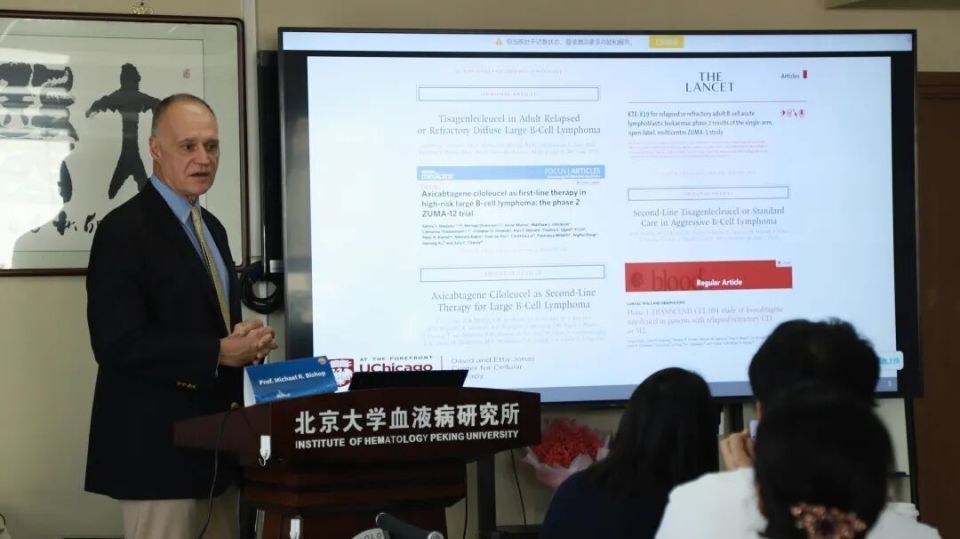
Michael R. Bishop教授现场作报告